

CoEIA Represented at the Cybercrimes and Digital Forensics Forum
Prof. Muhammad Khurram Khan spoke on strategies for capacity and capability building to address cybercrime at a three-day forum at Naif Arab University for Security Sciences attended by over 700 participants.
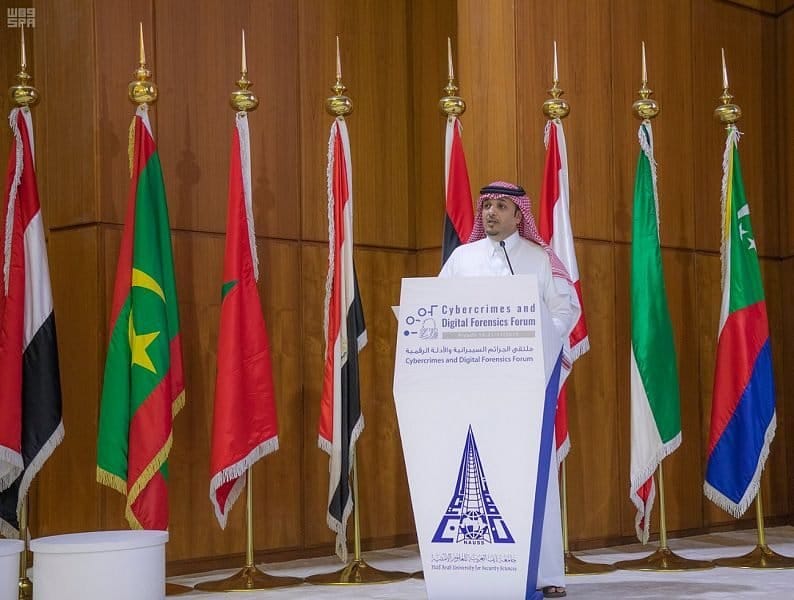
The Center of Excellence in Information Assurance (CoEIA) at KSU, one of the leading academic research centers in cybersecurity, was established in 2009 with the generous support of the Ministry of Education. Since its inception, CoEIA has contributed extensively to education, research, innovation, awareness, training and consultation in cybersecurity.
CoEIA, represented by Prof. Muhammad Khurram Khan, participated in a three-day forum on Cybercrimes and Digital Forensics held from 19 to 21 November 2019 at Naif Arab University for Security Sciences (NAUSS) in Riyadh. Attended by over 700 participants, the forum examined current issues, experience, practices and trends in education and training; the latest developments in research, technology and defensive strategies; and laws, regulations and principles of investigation in cybercrime and digital forensics.
In the opening ceremony, NAUSS President Dr. Abdulmajeed bin Abdullah Al-Bunyan outlined the university's initiatives, including plans for a diploma and master's program in cybercrime and digital forensics and state-of-the-art cyber forensics labs, and noted that the International Telecommunication Union (ITU) had chosen NAUSS as a Center of Excellence in cybersecurity and the Internet of Things (IoT).
The opening was followed by a panel on "Cybercrimes and Digital Forensics: Challenges and Opportunities" and an invited-speeches session on "Education and Training in Fields Related to Cybercrimes and Digital Forensics", chaired by Dr. Fatimah Alakeel, director of the training center at the College of Applied Studies and Community Service, KSU. Dr. Abdulrazaq Almarjan, Director of the Security Technology Department at King Abdullah University of Science and Technology (KAUST), discussed the cybercrime challenges and vulnerabilities facing public and private organizations.
Prof. Khurram delivered a speech on "Addressing Cybercrime Challenges: Strategies for Capacity and Capability Building", noting that data fraud and cyberattacks are now at the top of global risk agendas. "The financial price tag of global cybercrime in 2019 is expected to exceed USD 2 trillion and to reach around USD 6 trillion in 2021, more profitable than global drug trafficking. Its magnitude will grow with IoT, the Fourth Industrial Revolution, smart cities, 5G networks and cybercrime-as-a-service, and will be exacerbated by adversarial AI, machine learning and deepfakes," he said.
"The grand challenge in this field is not technology or processes; it is people and the human factor. We have a tremendous shortage of workforce, skills and talent. The world needs cybersecurity professionals, but also human resources in cyber legislation, law enforcement, cyber prosecution and cyber-criminal justice, a side that has been largely ignored and needs the attention of policy and decision makers," he added.
Dr. Moudhi Aljamea, General Manager of Digital Technology at STC Academy, discussed the importance of education and training in tackling cybercrimes and incidents, and Mr. Rasheed Al-Odah, Country Managing Director of Trend Micro in Saudi Arabia, presented the threat landscape and the role of education and training, noting that Saudi Arabia blocked the highest number of email threats (65,175,007) and malware threats (976,508) in the MENA region.
The forum also included workshops and invited speeches by local and international speakers on cybercrime laws, digital forensics strategies, legislation and law enforcement, as well as an exhibition by companies specializing in forensics and cybersecurity, with participation from public and private organizations, universities, research centers and law enforcement agencies from Arab, Western and Asian countries.
